
Before the Dome Opened Every Night: The Story So Far
Long before "astrotourism" had a name, people were already doing it — driving out past the streetlights, craning their necks, hoping for a clear night. Now it's one of the fastest-growing categories in experiential travel: dark sky tourism, or what some in the industry are calling noctourism, is projected to grow from a $10 billion market today toward $20 billion within the decade. For the past year, a night under a genuinely dark sky at Kosmos — a Bortle Class 2 zone, among the darkest skies rated on the nine-step Bortle scale — has been something you had to catch on a specific date. That's about to change. With our newly unveiled Welcome Lounge now open, Kosmos is moving from occasional star parties to standalone stargazing, available on a consistent basis. It's the single biggest shift in how we operate since we opened — and before we tell you what's next, we wanted to tell you how we got here.
Where It Started: Three Nights, One Confirmation
Last year, we hosted three star parties open to the community and the public. We didn't know exactly what to expect. What we got was a clear answer: people are hungry for this. Every event brought new faces from across Colorado — families, students, engineers, entrepreneurs, retirees, amateur astronomers, and plenty of complete beginners who'd never looked through an eyepiece — all standing under the same sky, for the same reason. Turnout grew each time, and so did something harder to measure: the sense that we'd found real, sustained curiosity about the cosmos that a single night could only partly satisfy.
That confirmation is the entire reason the Welcome Lounge exists. You told us, three times over, that occasional wasn't enough.
The Night That Proved It: Our Day & Night Party
Our largest event to date brought stargazing and a full planetarium show together under one roof for the first time — a full day-into-night, immersive experience for guests who wanted more than a few hours after sunset. At the center of it was an inflatable dome housing a Digitalis digital planetarium system — guests moved from our telescopes outside, still adjusting to dark adaptation, into a full-dome sky show inside, without ever leaving the party. It's exactly the kind of social-media-ready, only-here experience that's fueling astrotourism's appeal with younger travelers — a 2024 Priceline survey found roughly a quarter of Gen Z travelers are now planning trips specifically around astrotourism, and "SpaceTok" content has turned amateur astronomy into a genuine youth travel trend. The numbers told their own story. In the final push before the event, our marketing team shared this update with the team:
"Some event insights so far: +$1,000 in tickets. 53 community members expected. 7 students + 1 professor. We're already seeing better numbers compared to the last event!"
That growth — event over event — is what told us this wasn't a novelty. It was a pattern.
(A full photo gallery from the Day & Night Party is available here, and you can revisit the original event page on Facebook.)
When the Cosmos Brought a Classroom to Us
One of the nights we're proudest of wasn't one we organized — it was one that came to us. On August 16, a group from the University of Colorado Colorado Springs (UCCS) chapter of the American Institute of Aeronautics and Astronautics (AIAA) made the trip to Mosca for an evening under our Bortle Class 2 skies. Afterward, faculty advisor Dr. Lynnane George wrote about the experience for her department in a short report (read the full writeup here):
"It was a great opportunity for the students to meet and discuss the night sky with other like-minded individuals."
Josh Pappas, the AIAA student branch president, put it more personally:
"I grew up the son of a Park Ranger at a National Park in West Texas. As a kid, I would look up at the stars in wonder at the brilliance of the Milky Way in the sky. Our time at Kosmos made me a kid again."
And Kartik Krishna, a Colorado entrepreneur who joined the group, described watching the sun through one of our Celestron telescopes — filtered for safe solar viewing — and learning about solar flares as "a WOW moment." That was one of several: guests traced constellations with a green laser pointer, picked out deep-sky objects through our 11-inch Dobsonian's wide aperture once full dark set in, and caught a couple of Starlink satellites drifting silently overhead.
Dr. George summed up the night simply: "Events like these bring science to life." The group's visit was significant enough that it became the subject of a short written piece from the department — a level of recognition we don't take lightly.
The Voices That Joined Us
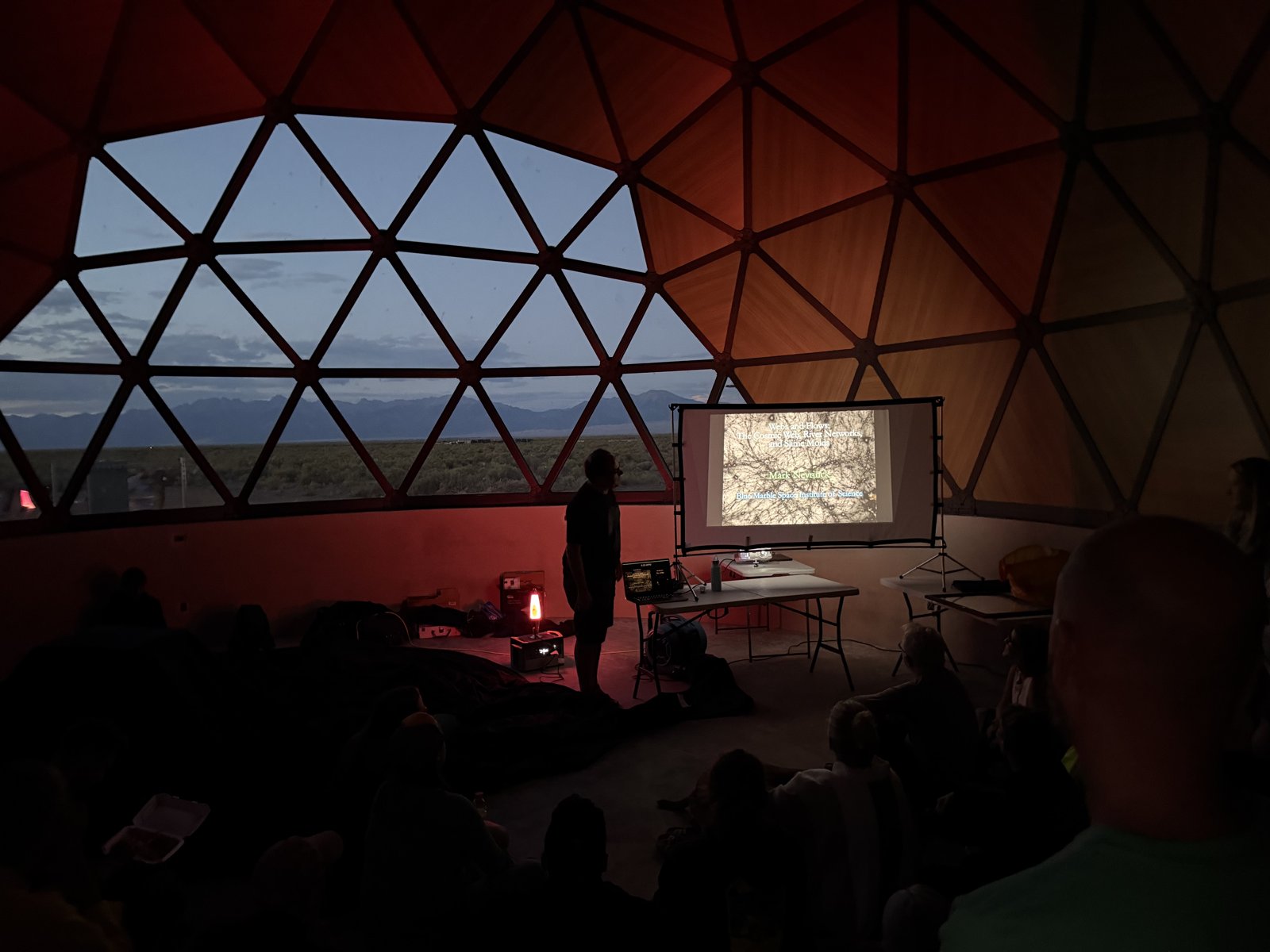
Nights like these have also brought us people who don't just attend — they add to the conversation. Denver-area astronomer and science communicator Mark Neyrinck, a Research Scientist at the Blue Marble Space Institute of Science, joined us after connecting with Kosmos online, drawn by an idea that turned out to fit remarkably well with what we're building: relating the cosmic web of galaxies — the vast filament structure that connects clusters of galaxies across the universe — to more familiar systems here on Earth, like rivers and erosion. It's a fitting parallel, given our location near Great Sand Dunes National Park. During his visit, Mark shared some of his own long-exposure astrophotography with the group — a reminder of just how much detail a truly dark sky gives up to anyone willing to point a camera at it and let the shutter stay open.
Mark also pointed us toward a colleague, Dr. Graham Lau, also of the Blue Marble Space Institute of Science, a fellow science communicator whose work we hope to feature in the future.
These aren't just guest appearances. They're a sign of the kind of community — working scientists, citizen astronomers, and the simply curious — that's forming around what happens at Kosmos after dark.
What This All Adds Up To
Three community star parties. A Day & Night Party that outperformed the one before it. A university department that wrote about us. Working scientists who sought us out. Taken together, it wasn't a hint — it was a mandate. People don't want to wait for the next announced date. They want the option to look up whenever the sky is clear and the moon phase cooperates.
That's what the Welcome Lounge changes. For the first time, Kosmos can offer standalone stargazing on a consistent basis — not just when we host a party, but as a standing part of what we do. It's our answer to a simple, growing demand: guests who want a genuine dark-sky experience, deep-sky views through real optics, and an experiential, DarkSky-conscious place to stay, without needing to build a trip around a single event date.
This is the first post in a short series leading up to what's next. In our next post, we'll introduce the newly restructured stargazing packages built for this new chapter — designed around everything the last year taught us about who's showing up, and why.
Explore the cosmos with us. More to come.
The Dark Sky Journal
Get the next issue in your inbox
Meteor shower dates, dark sky travel guides and gear picks — plus the build updates, telescope nights and behind-the-scenes stories from Kosmos we don't post anywhere else.
No spam. Unsubscribe anytime.
Latest Posts

Kosmos Resort fall activities for 2026: new-moon stargazing windows, Saturn at opposition, astronomer-led tours from $99, and Great Sand Dunes in fall gold.
Three years ago today, the founder of Kosmos camped off-grid on empty land to launch the resort. What changed since, from first guests to DarkSky certification.


